Designing the Optimal Recovery for Wasted Copper
How Chronotope modeled copper recovery from slag and optimized leaching for a process where extraction efficiency can increase from 70% to over 92%, turning currently lost copper into a major economic lever at large-site scale.

The Copper is Already There
As energy demand rises driven by AI investment and the corresponding data centers, copper has re-emerged as a power player. The faster electrification happens, the more pressing the need becomes for the material that sits beneath power grids. Yet primary supply remains constrained, relying on a chain of mining, transportation, crushing, concentration, smelting, refining, and logistics infrastructure that takes years to build and expand.
That makes secondary recovery particularly relevant, with copper slag increasingly interesting. The next generation of copper supply will not come only from new mines. It will also come from using already-mined materials more intelligently.
Slag is not a new orebody. It is a material the industry has already paid to mine, move, process, and smelt. It sits at the end of a long industrial chain, often treated as a residue, even though it can still contain recoverable copper and other valuable metals.
The difficulty is that slag is not one uniform material. Its composition changes with ore source, smelting practice, cooling history, and mineral phases. Copper can be locked inside different chemical and physical structures, so the right leaching extraction method ends up being dependent on complex emerging properties that appear when these structures interact with each other and with the environment. There is no clean one-to-one mapping between single factors and final copper recovery. Acid concentration, temperature, oxygen pressure, pulp density, particle size, and leaching time all matter, but their effect emerges from the way they interact. A higher temperature can change the value of residence time. Acid concentration can behave differently at different pulp densities. Oxygen pressure can help in one reaction environment and add little in another. The recovery window is hidden inside the emerging behavior driven by all those together.
Chronotope built models that capture the raw materials, interacting chemistry and operating conditions behind copper slag processing, and used those relationships to design the optimal leaching to maximize copper throughput and the corresponding economic upside.
Reconstructing The Leaching Data
The mining space is characterized by the rather limited usable data available. We built our own database by scraping copper slag leaching experiments from the literature, cleaning the extracted records, standardizing the variables, and engineering the dataset into a form the model could learn from.
The final dataset contained 265 rows. Each row connected measured copper leaching efficiency to process conditions and slag chemistry. The target was copper leaching efficiency, and it was tied to features like acid concentration, temperature, pulp density, oxygen pressure, particle size, leaching time, and feed-composition variables: Cu, Zn, S, Fe, Al, and Si.
The raw columns were not enough. Since copper recovery is driven by emerging process behavior, and not a one-to-one mapping from any variables to yield, we engineered interaction features that captured the coupled leaching environment, such as acid × time, oxygen × temperature, and pulp density × acid.
The exact interactions that the model should learn from were derived through an agentic loop. Agents iteratively moved through data extraction, auditing, cleaning, feature construction, model selection, benchmarking, tuning, and reproduction. That loop lets us compare process-only, composition-only, raw combined, transformed, and interaction-based routes, to then identify which emerging process relationships actually carried the signal.
Mapping Emerging Features to Copper Yield
Once the data was reconstructed, we trained a model that could quantify the impact of each property on the final yield. It was determined that the best model was Gaussian Process Regression with standard preprocessing and a kernel designed to capture nonlinear behavior while preserving uncertainty.
Across repeated train-test validations, the model achieved a mean test R² around 0.94 and a mean test RMSE around 6 percentage points for copper leaching efficiency. That means the model explained nearly all of the measurable variation in copper recovery, and its predictions were incredibly close–typically within about six recovery points–to the experimental results.
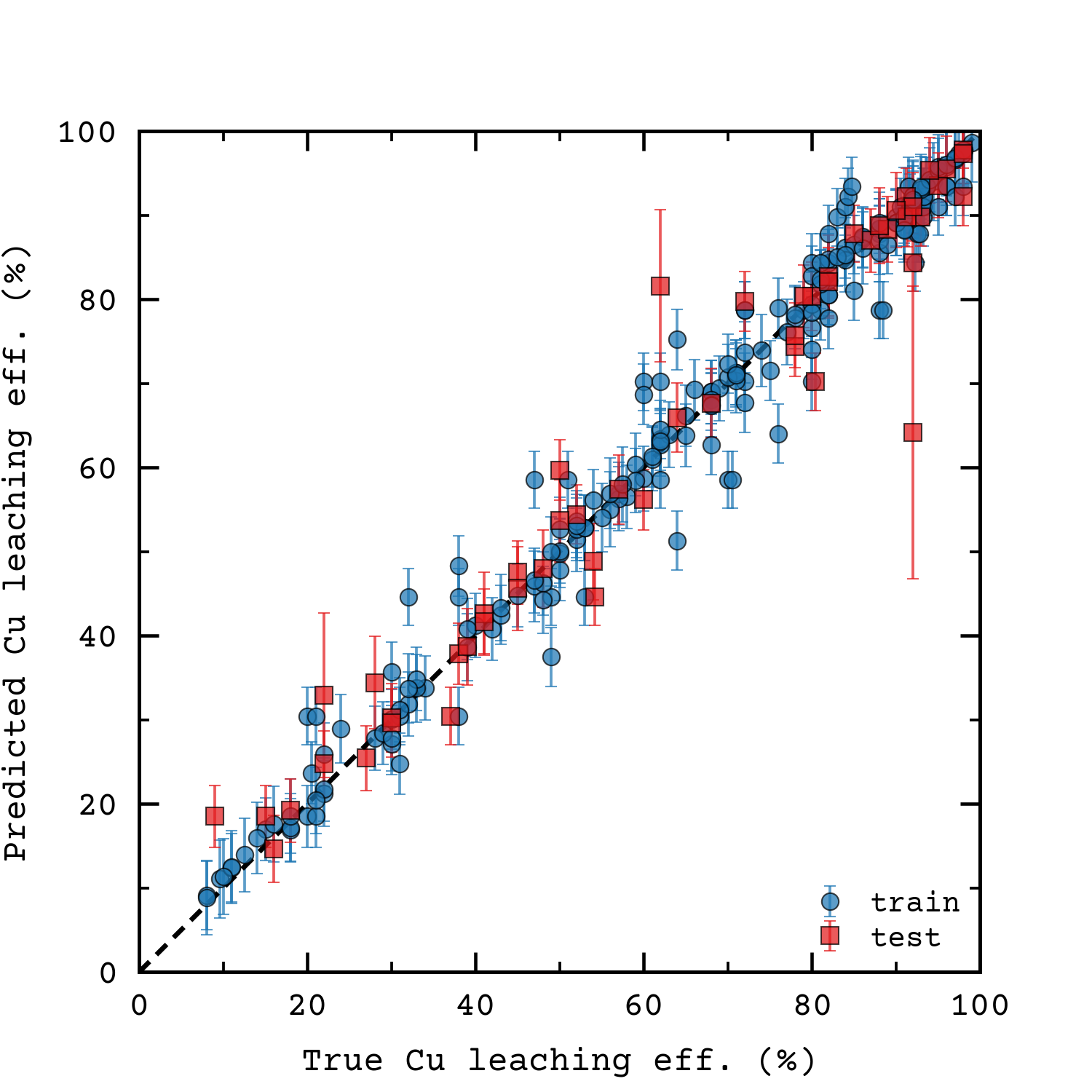
That performance matters because the model is no longer just interpolating between isolated experiments. It captures the shape of the leaching surface well enough to screen operating windows: which variables move together, where recovery starts to plateau, and where additional process severity is unlikely to buy much more copper.
The Sweet Spot
Having such an effective predictor, a common error would be to maximize for the copper leaching efficiency alone. But if we use, for example, too much acid, or run the reaction for too long, we could end up generating less value even if we extract more copper. We need to find a process that recovers copper without spending away the value of the recovery.
To model that tradeoff, we built a burden-adjusted recovery score. The score rewards predicted copper recovery and penalizes process burden from acid usage, temperature, oxygen pressure, leaching time, pulp density, and particle-size-related grinding burden.
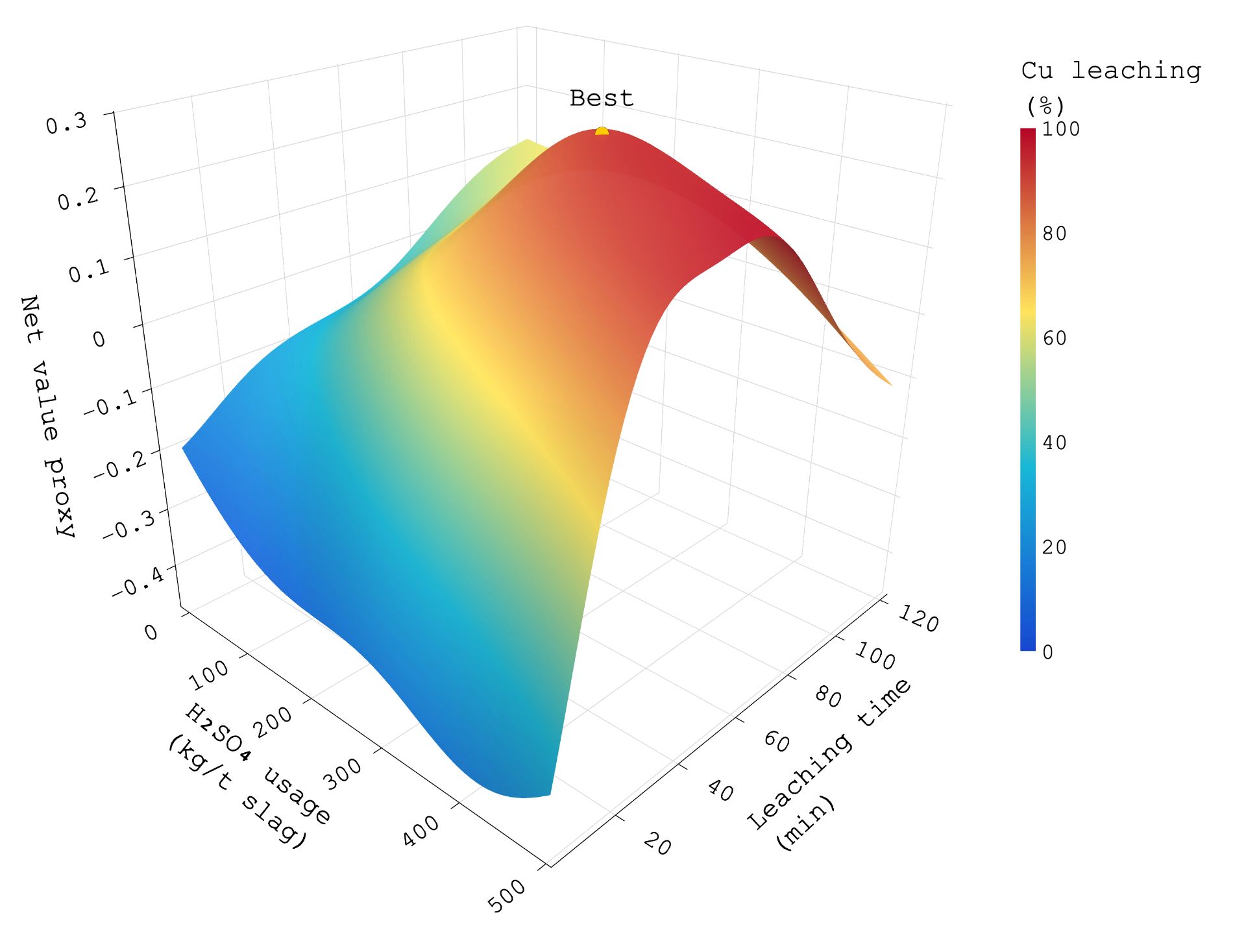
Non-trivially, the best region was not the most extreme region. Our model identified an intermediate acid-time window where copper recovery stayed high while process burden remained controlled. The best point sat near the high-recovery plateau and not at the maximum-acid or maximum-time corners.
Interpretability
Given the multi-billion dollar market centered around copper extraction, better industrial processes imply the same level of capital investment. At that scale, the decisions that will drive said investments deserve the highest rigor.
For that reason, it is not only important to understand what is the best configuration for the process, but why. We analyzed which variables were pushing predicted recovery higher or lower. Around the optimized region, the strongest positive drivers were interaction terms: time × temperature, acid × time, oxygen × time, and leaching time itself. As expected, acid concentration and temperature independently also contributed positively, while particle size contributed negatively, consistent with larger particles limiting access to reactive surfaces.
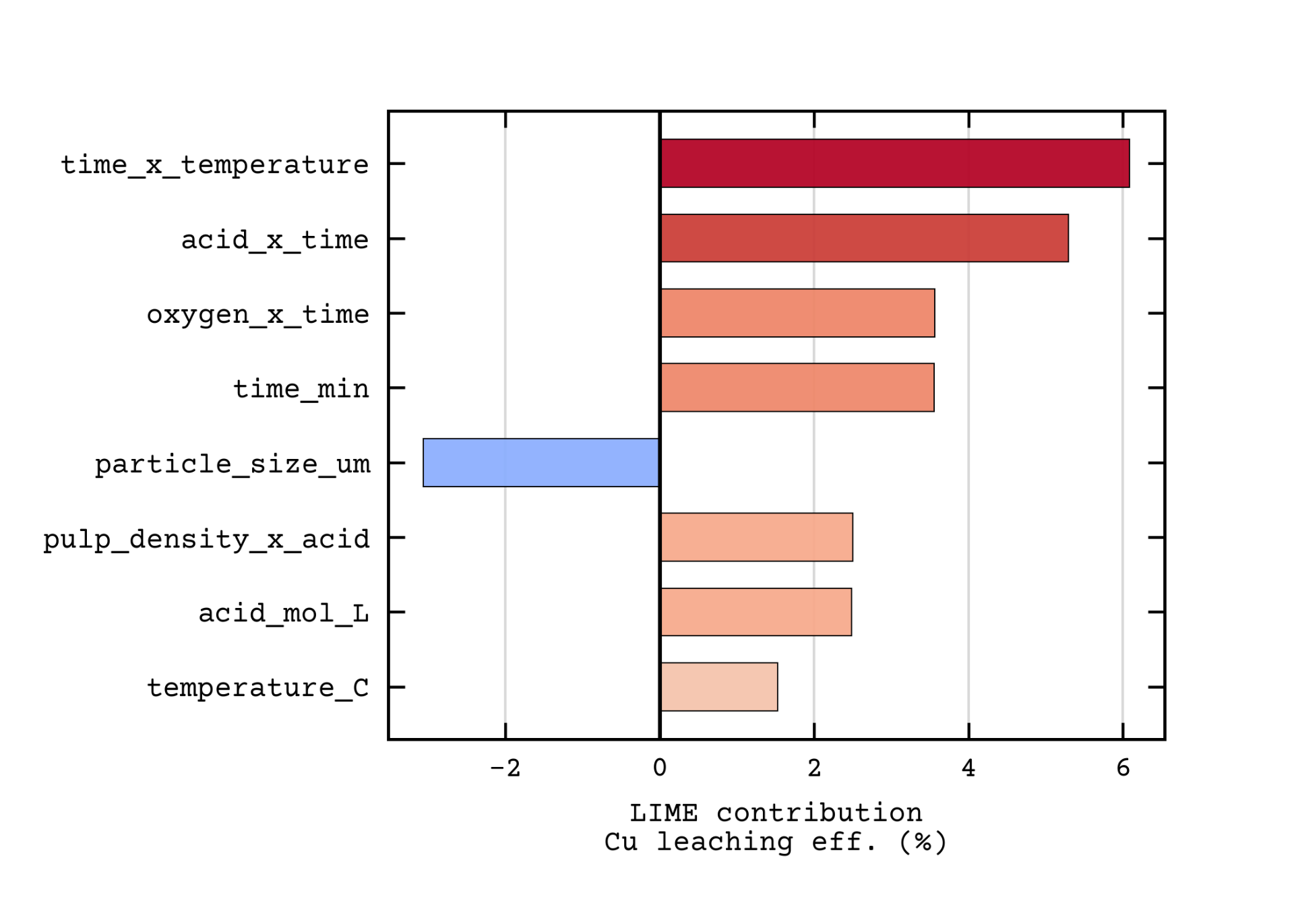
Copper dissolution depends on reaction time, chemical driving force, oxidizing environment, thermal activation, and surface access, and we can now quantitatively understand how heavily on each.
Generalizability
The specific environment in which the leaching will happen varies from site to site, and from company to company. The initial conditions are different, and so are the constraints. Not all companies have the same budgets or access to the same acids, for example, and some projects operate on tighter deadlines than others. Having quantified the impact of each feature and the properties that emerge from their interactions allows us to account for that.
We can now adjust on demand the slag chemistry, the operating conditions, and the customer-specific constraints to then estimate their copper recovery, inspect uncertainty, and see how the optimal leaching window moves.
The Value
The value of this technology becomes more than evident at scale, evaluating the impact on a representative copper smelting company producing 500,000 tonnes of refined copper a year. Smelting produces roughly 2.2 tonnes of slag for every tonne of refined copper, which gives about 1,100,000 tonnes of slag per year. Copper slag commonly contains about 0.5% to 2% copper; using a middle-of-the-road 1.5% grade, that annual slag stream contains about 16,500 tonnes of copper. At recent LME copper cash prices of about US$13,615 per tonne, that is roughly US$225 million of gross contained copper in the annual slag stream.
A traditional recovery circuit already recovers slightly over 70% of that copper from the slag. Using that number as a baseline, that site would recover about 11,550 tonnes of copper-equivalent per year from slag. The remaining unrecovered copper would still be about 4,950 tonnes per year, or over US$67 million of gross metal value wasted.
Each additional recovery point is about 165 tonnes of copper per year. At current copper prices, that is about US$2.25 million of gross metal value. We got it up to over 92%. This represents nearly US$50 million per year in additional gross copper value recovered at this scale.
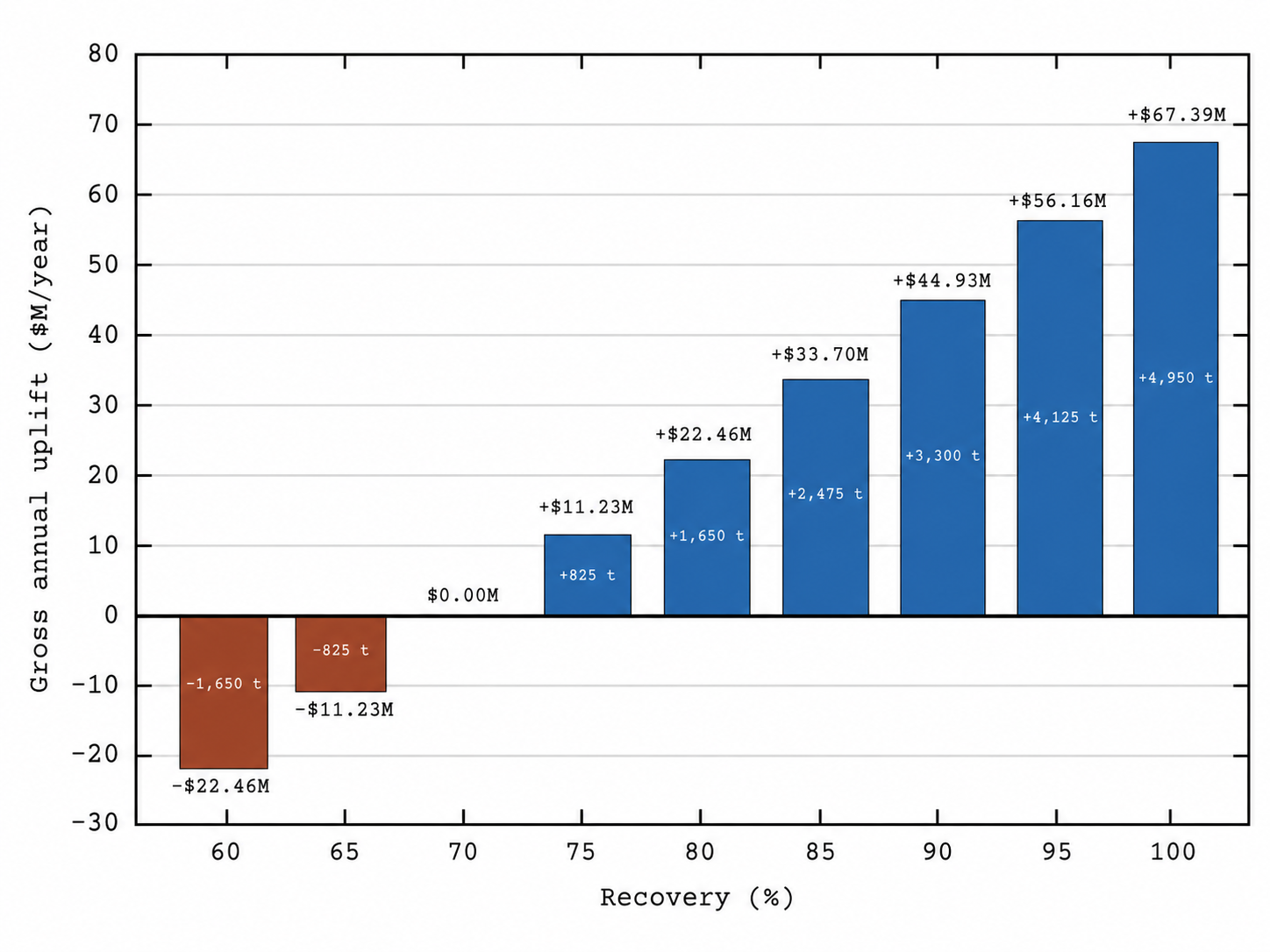
The economic impact from the extraction optimization is very attractive. For major producers or multi-site operators approaching 1 million tonnes per year, the same model implies about US$135 million per year of unrecovered gross copper value and roughly US$4.5 million per year for each additional recovery point. Now this is not net profit. Materials used, energy consumption, downstream purification, equipment limits, and refining terms all matter. But that is exactly the point.
A model that only maximizes copper recovery is incomplete. We can now maximize economic returns instead.
The Actionable Output
The final output is an explicit operating window for copper slag leaching: expected recovery, expected burden, uncertainty, and the physical drivers behind the recommendation. The value is not that computation replaces metallurgy; it changes where process development starts, how quickly it moves, and how much economic value it returns.
Copper obtention from slag should be a trivial decision. The material has already undergone the most expensive part of mineral extraction. Yet it has not been so because we did not understand the emerging properties of the system well enough to design the obtention process around them. But now we do.
Instead of testing blindly across acid, temperature, oxygen pressure, pulp density, particle size, and time, heavily constrained by budget and project limitations, we can now design the optimal copper extraction from slag.
This is the pattern Chronotope is built for. Across the mining space, companies face the same structure of problem: unknown scenarios, fragmented data, complex physical interactions, simultaneous constraints, and expensive experiments.
Chronotope turns those problems into directed search. We build models around the decision a technical team needs to make.
For copper slag, that means making the recovery window visible: where more copper can be recovered, where additional severity stops paying, and why the model believes that region is worth testing.
The future–and now present–of R&D is not trial and error. It is a straight path to the materials that will shape the world.
If you or your company want to be part of it, contact us to explore what's possible at contact@chronotope.ai.