From One Million Polymers To A Production-Level Structure
How Chronotope screened a million candidate polymers to identify the ideal structures for sustainable high-barrier packaging.
Understanding The Problem
An outstanding market need is replacing conventional high-barrier materials in rigid food packaging for sustainable alternatives. The reason this is still an open problem is that packaging formulations must balance multiple properties at once: low oxygen permeability, high hydrophobicity, processable thermal behavior, and synthetic accessibility. The hard part is not improving one property. Many polymers can look good on a single metric. The hard part is finding structures that satisfy all of the requirements at once. A polymer with strong oxygen barrier performance may be too hydrophilic; one with the right surface behavior may fall outside the processing window; a high-performing candidate may be too difficult to synthesize or too far from known chemistry to justify immediate development.
That is the bottleneck in many polymer-manufacturing programs. The search space is enormous, the data is messy or incomplete, and broad synthesis campaigns are too slow to explore more than a tiny fraction of what might work. Such a specific combination is needed for all the required properties to align, so it becomes a long-horizon task just to know which polymer candidates are worth looking at.
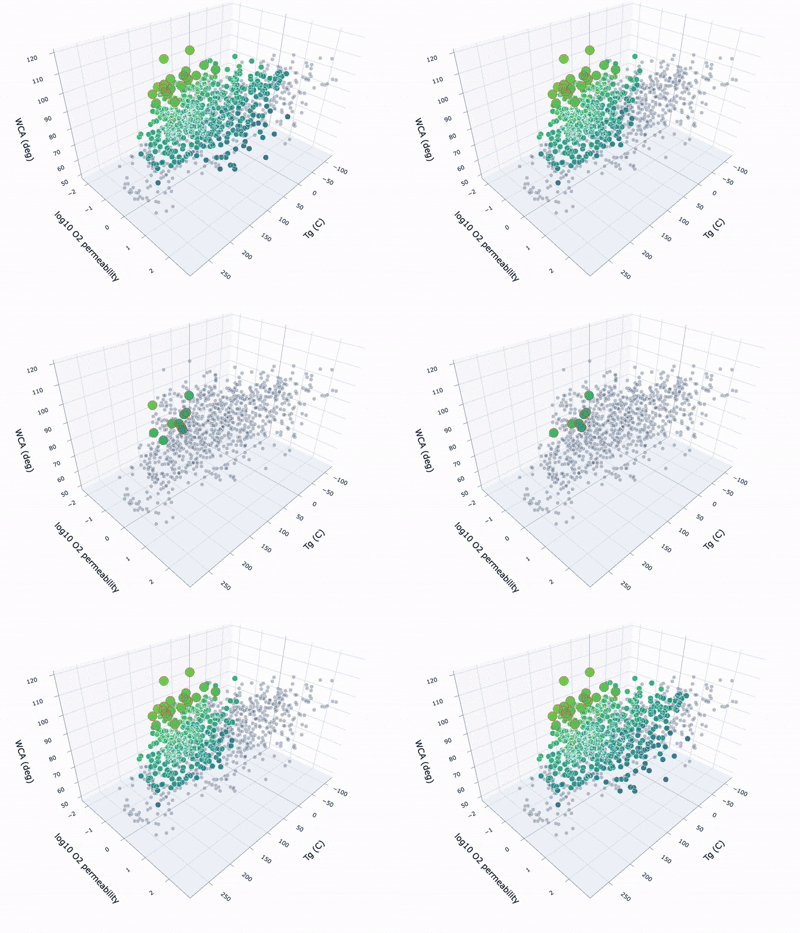
Chronotope built models that went far beyond that question: we turned a million-polymer search into an explicit shortlist of the best candidates to use for sustainable packaging materials. Each recommendation balances performance, feasibility, and chemical rationale, giving the team a clear answer to the decision that mattered: what to research and develop, and why.
Building From The Data That Exists
The available data looked like that of most industrial teams: small and fragmented, often only hundreds of usable experimental labels scattered across lab reports and datasets. To solve that, we consolidated several primary sources extracted from open literature. Even then, after using our data-cleaning agents, the working, labeled dataset only contained 588 unique polymers.
The coverage was uneven across the critical properties. There were 304 polymers with glass transition temperature measurements, 332 with oxygen permeability measurements, and 84 with water contact angle measurements. That means each property had to be modeled separately, with uncertainty treated as part of the result.
The data scarcity implied that the models would have to learn the intrinsic physical behavior of the structures in order to predict the properties of a fully novel polymer.
Training Models Against Development Constraints
For each target property, we trained an ensemble of physics-informed neural networks (PINNs) on two complementary representations of polymer structure.
The first representation captured each repeat unit from its pSMILES string, allowing the model to learn structural patterns directly from the polymer sequence. The second encoded interpretable chemistry: atom-type fractions, functional group counts, aromaticity, ester and ether content, amide and imide linkages, chain flexibility indicators, and the graph distance between backbone connection points. Together, these features allowed the models to scale to a million candidate structures while preserving chemical visibility.
An independent set of predictive architectures was trained on each target property. Uncertainty was built into the models. For each property, multiple models were trained with different random seeds, and the spread across the ensemble was used as a practical uncertainty estimate. Candidates with strong predicted performance but large ensemble disagreement were treated more cautiously and penalized in the final screen.
On held-out test sets, the glass transition model achieves RMSE = 47.4 K and R² = 0.73. The oxygen permeability model achieves RMSE = 0.97 log₁₀(Barrer) and R² = 0.70. In practice, the R² values mean the models capture the majority of the measurable variation in polymer behavior. The RMSEs show that the predictions remain within reasonable quantitative estimates of the true experimental values; the oxygen permeability error, for instance, is reported on a logarithmic scale, so an RMSE near 1 corresponds roughly to predictions being within about one order of magnitude of the experimental value on unseen polymers. The water contact angle model has the smallest training set, so its higher uncertainty is carried directly into the screening score rather than hidden behind a point estimate.
Identifying the Physical Correlations
A ranked list is not enough in materials development. Companies need to understand why a candidate is promising, what tradeoffs it carries, and which structural features should be preserved if the molecule needs to be modified for synthesis or scale-up.
We used SHapley Additive Explanations (SHAP) analysis to identify the complex correlations between each specific structural aspect and the observed properties. For example, we identified which features in particular drive the glass transition predictions. The model recovered known structure-property relationships: aromatic motifs and carbonyl-containing fragments tended to raise Tg, while flexible aliphatic patterns and ether-like oxygen linkages tended to lower it. Descriptor-level analysis showed that sp³ carbon fraction and polar groups were among the strongest predictors, linking the model's behavior to chain flexibility and repeat-unit rigidity.
That gave the recommendations a chemical explanation. The workflow was identifying why certain regions of polymer space were more promising than others, so it gives clear actionables on what to optimize.
Screening The Candidate Space
With the property models and uncertainty filters in place, we screened PI1M, a virtual library of approximately one million polymers that could potentially be manufactured. Each candidate was scored across five dimensions: predicted oxygen permeability, predicted water contact angle, predicted glass transition temperature relative to the processing target, synthetic accessibility, and prediction confidence.
The scoring reflected the market-derived objective: what the ideal polymer should be in order to be used for the packaging to reach production scale. Oxygen barrier performance and water resistance were primary requirements. Glass transition temperature and synthetic accessibility acted as feasibility constraints. Uncertainty penalized candidates that looked promising but were too far from known commercial viability.
That reduced the million-scale library to a focused set of candidates worth experimental review. The exact lead structures and rankings are not disclosed here for confidentiality and intellectual property reasons. In a development program, those recommendations are the commercially valuable part of the work. What can be shown publicly is the decision logic: how the search space was narrowed, what constraints were enforced, how confidence was measured, and why the recommended direction was chemically and commercially credible.
The Actionable Outputs
The final output is an explicit shortlist of what polymers to look into developing for sustainable rigid food packaging. The value is not that computation replaced research; it rather changes where synthesis starts. Instead of launching a broad trial-and-error campaign, now the starting point is a ranked set of candidates that already satisfied the core market, processing, and feasibility constraints.
This is the pattern Chronotope is built for. Across materials, chemistry, formulation, process optimization, manufacturing, and quality control, companies face the same structure of problem: fragmented data, enormous search spaces, simultaneous constraints, and expensive experiments.
Chronotope turns those problems into directed search. We build models around the decision a technical team needs to make: which material to synthesize, which formulation to test, which process window to explore, which experiment to stop, and which candidate deserves investment.
The future–and now present–of R&D is not trial and error. It is a straight path to the materials that will shape the world.
If you or your company want to be part of it, contact us to explore what's possible at contact@chronotope.ai.